We have a new review article out in Journal of Virology:
Rift Valley Fever: a Threat to Pregnant Women Hiding in Plain Sight?
This was fun to write! A mix of history and the current state of the field of RVFV infection during pregnancy.

Your Custom Text Here
We have a new review article out in Journal of Virology:
Rift Valley Fever: a Threat to Pregnant Women Hiding in Plain Sight?
This was fun to write! A mix of history and the current state of the field of RVFV infection during pregnancy.
As of April 1st, 2021, I will officially be an Associate Professor with tenure. Just writing that feels so weird and crazy and unlikely and exciting. I have some thoughts.


In the summer of 2007, when a job opportunity came up at Pitt in the newly formed CVR as Research Manager of the RBL, and I said to my husband “I want to move back to Pittsburgh.” He said ok. And we did it. I am forever thankful for this. Luke was only 9 months old.
I tell people all the time that I didn’t want to run my own lab and be a tenure-track faculty member. Why? I didn’t think I could do it. There weren’t very many examples of successful women faculty members with families (I am reminded of that saying: if you can’t see it, you can’t be it). I saw single, unmarried men come into this job and fail. If they failed, how could I possibly do it? My mind could not calculate it.
So I took an administrative job when I came back to Pitt. I am incredibly thankful for this opportunity that was presented to me. A lot of folks gave me a chance. I appreciate that more than can be expressed. I learned a lot with this new job, and it allowed me the ability to get my feet under me while my kids were young. Lots of stuff happened. Some good, some not good. Caroline was born in 2012. I kept going. I told myself that I’d keep going with this job until someone told me I couldn’t do it any longer, and then I’d figure something else out. So far, I’m still here.
Some combination of perseverance, working hard, and serendipity. Learning curve was and still is STEEP. Thankful for all those who tolerated my mistakes and helped me through it. You know who you are.
In addition to my husband, I have to thank my parents, my in-laws, our wonderful long-time nanny Martha, our kid’s preschool La Escuelita Arcoiris, and Falk Laboratory School - all of these loving family members and support people and institutions supported my family as I worked my way through. All of the conferences and meetings and grant review panels that my parents and in-laws helped with the kids. It truly DOES take a village. I love my village!
I’ve cried in my office on quite a few occasions.
All of my students and staff over the years - from Amy Caroline (my first MS student!) to my first staff members (Jacqui! Laura! Diana!) - thanks for helping me learn how to manage a research team. This is still a work in progress….Each and every one of them taught me something valuable. I remember them all.
I’m quite aware by this time of my strengths and weaknesses. I try to focus on improving the weaknesses, but its tough to teach an old dog new tricks.
Bottom line is that I like this job way more than I ever expected to. I didn’t think I’d love running a research lab. Its intimidating as hell. Writing grants and papers is (dare I say) kind of fun. I only wish I had more time to focus on those aspects and spend less time on paperwork and email.
Running a research program on emerging viruses during a global viral pandemic has been, well, interesting to say the least. 2020 seems like a blur - the March - July time period was the most intense time professionally and personally that I have ever experienced.
The Hartman Lab is in a great place right now. We have several exciting projects that are just getting started. I’m building the lab off of a great base that we’ve established the past few years. I am SO excited to see where these lead to. I have some awesome collaborators that are fun and fulfilling to work with. I want to keep working with good scientists and good human beings. Our new CVR leadership is taking us in a thrilling direction. The future is bright.
I hope to be able to get back in the lab more myself, even if its just to pipet liquids from one container to another. And even if I need to ask where everything is kept these days.
My kids are getting older now (Luke is starting high school in the fall - OMG) and life just feels different. Good different. Deep breath. Tears of joy.
Its lambing season, so Cindy has been out collecting placenta from local farms. All hands on deck to process all of these fascinating organs!

Cindy and her little lamb

Fresh sheep placenta

Rotation student Justin Dutta helps out with the placenta processing
Our new manuscript is up online at PLOS Pathogens:
Albe, J.R., H.M. Ma, T.G. Gilliland, C.M. McMillen, C.L. Gardner, D.A. Boyles, E.L. Cottle, M.D. Dunn, J. Lundy, K.J. O’Malley, N. Salama, A.W. Walters, I. Vasile-Pandrea, T. Teichert, W.B. Klimstra, D.S. Reed, and A.L. Hartman. In press. Physiological and immunological changes in the brain associated with lethal eastern equine encephalitis virus in macaques. PLOS Pathogens. Accepted 1/12/21. Available online: https://doi.org/10.1371/journal.ppat.1009308.

This figure shows the different subsets of immune cells present in the brains of EEEV-infected animals compared to controls (gray bars). Not that some cell types remain elevated in surviving animals (blue bars in panel B).
Take home message: The goal of a study like this is to better understand the pathophysiology of disease, so that these parameters can be used in vaccine and therapeutic as markers of efficacy. For instance, if we understand how brain waves, intracranial pressure, cytokines, and cell infiltration change as a result of disease, we can measure these parameters in treated/vaccinated animals. A reduction or amelioration of the changes can be used as a statistical measurement of efficacy. In this case, we were surprised to find residual viral RNA and immune cell infiltrate in the brains of surviving animals, because these animals seem otherwise healthy and we did not appreciate that EEEV may still be reaching the brain in survivors. Further studies will reveal whether EEEV actually penetrates the brain of survivors.

Here’s a sneak peek at the tremendous cytokine dysregulation in the brain of animals with lethal encephalitis.
We have a new paper accepted in PLOS Pathogens on the pathogenesis of eastern equine encephalitis virus (EEEV).
This is a culmination of several years of work with the Reed and Klimstra labs.
Title: Physiological and immunological changes in the brain associated with lethal eastern equine encephalitis virus in macaques
More to follow soon!
We have a new manuscript in press at Journal of General Virology!
Boyles, D.A., M.M. Schwarz, J.R. Albe, C.M. McMillen, K.J. O’Malley, D.S.Reed, and A.L. Hartman. In press. Development of Rift valley fever encephalitis in rats is mediated by early infection of olfactory epithelium and neuroinvasion across the cribiform plate. Journal of General Virology. Accepted 10/30/20.
Devin and Maddy are co-first authors. Check out the awesome figure of rat olfactory anatomy:
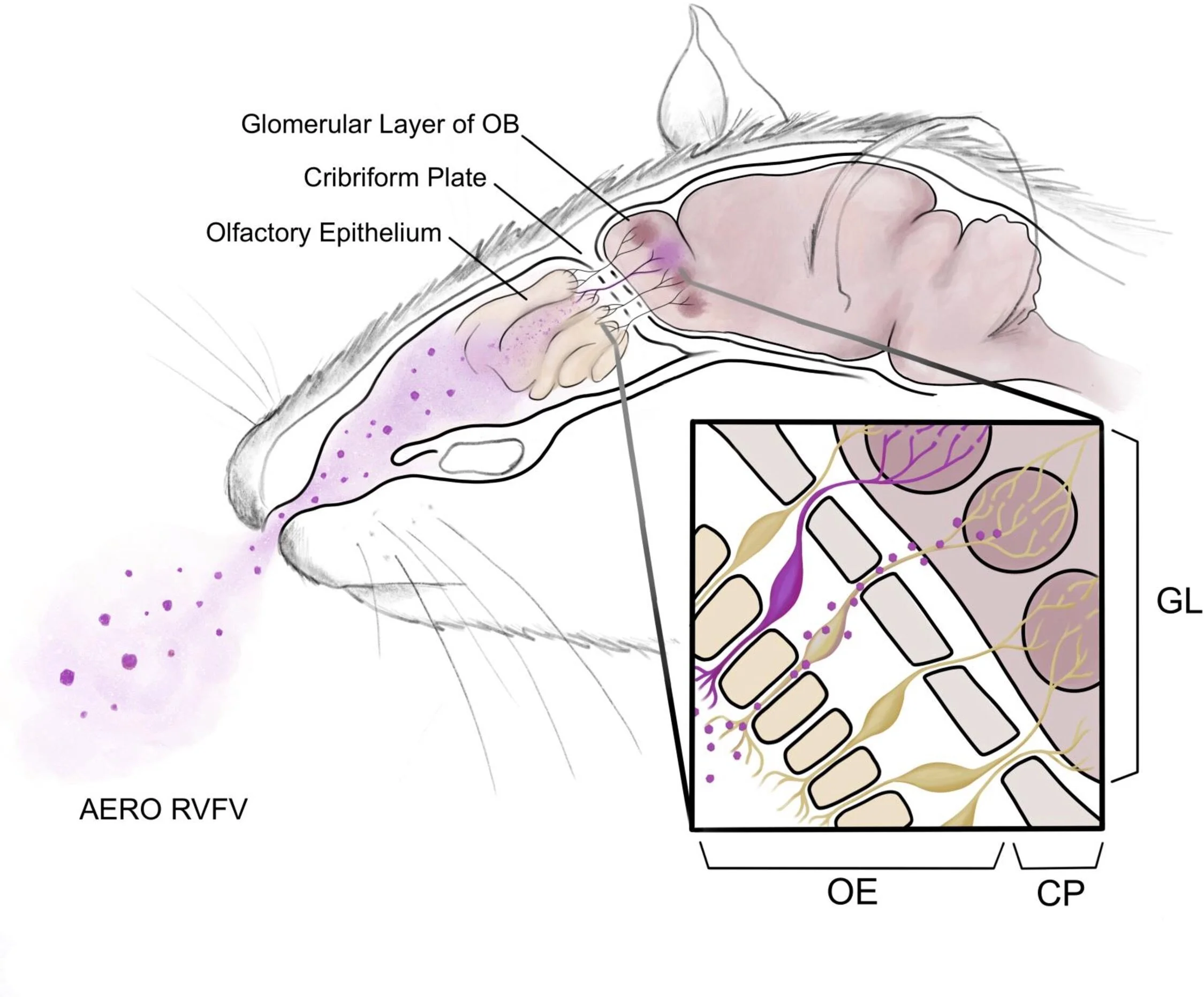
Illustration by @HaleyNordstrom

This week we had to say goodbye to Joe, who’s been with me for 5 years. He started as an MPH student in 2015 and stayed on as my most senior tech integral to all the projects in our lab. He’s off to grad school in Seattle. Best of luck, Joe!
Check out our photos page for more pictures from his (socially-distanced) going-away picnic.
The Klimstra et al. manuscript is now published in Journal of General Virology:
The Hartman et al. manuscript on AGMs is accepted at PLOS Pathogens. Link to come soon.
PREPRINT: SARS-CoV-2 growth, furin-cleavage-site adaptation and neutralization using serum from acutely infected, hospitalized COVID-19 patients. Preprint: BioRxiv https://doi.org/10.1101/2020.06.19.154930
PREPRINT: SARS-CoV-2 infection of African green monkeys results in mild respiratory disease discernible by PET/CT imaging and prolonged shedding of infectious virus from both respiratory and gastrointestinal tracts. Preprint: BioRxiv https://doi.org/10.1101/2020.06.20.137687
Comparative dynamic aerosol efficiencies of three emergent coronaviruses and the unusual persistence of SARS-CoV-2 in aerosol suspensions
https://doi.org/10.1101/2020.04.13.20063784
Applications of minimally invasive multimodal telemetry for continuous monitoring of brain function and intracranial pressure in macaques with acute viral encephalitis.