
Our very own Austin Hertel’s 2nd publication as first author was just made available in the American Society for Microbiology’s mBio! “Maternal vaccination protects dams and prevents in utero transmission of Rift Valley fever virus in rats,” focuses on vertical transmission of Rift Valley fever virus (RVFV) between mother and fetus in rats, specifically evaluating the safety and protective ability of a live-attenuated RVFV vaccination in dams.
RVFV causes spontaneous fetal loss among domesticated livestock populations, and has also been shown to cause fetal loss and hepatic disease in human infants born to pregnant individuals infected with RVFV. The disease poses a serious threat to vulnerable pregnant populations, especially without licensed vaccines currently available for human use. Previously developed live-attenuated vaccines retained partial virulence causing fetal death and congenital defects and thus are not suitable for human use. The vaccine used in this study is a live-attenuated version of the ZH501 strain of RVFV which has been generated by reverse genetics to lack the virulence genes encoding the non-structural proteins NSs and NSm. Vaccination with RVFV-delNSs/Nsm protects mother and fetus from wild-type viral challenge while also being avirulent.
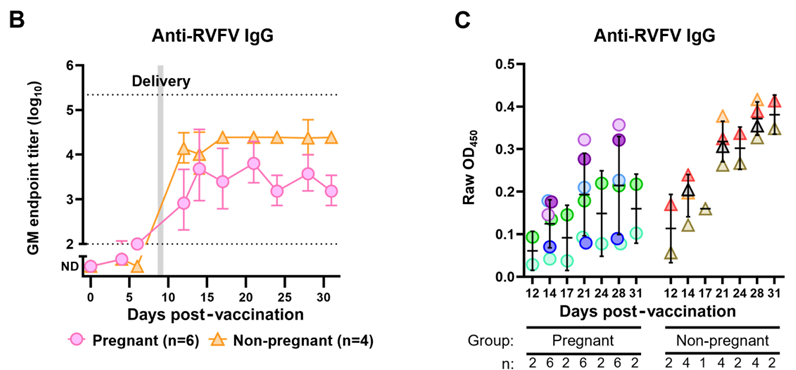
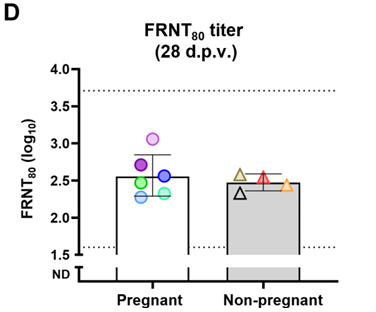
Immune response titers demonstrated pregnant and non-pregnant rats responded similarly to vaccination with RVFV-delNSs/NSm. Titers of RVFV-specific IgG1 and IgG2a in pregnants rats vaccinated with the live-attenuated RVFV strain indicated the Th2- and Th1-mediated responses of rats are similar regardless of pregnancy status. There were some slight differences in IgG response, although neutralization capacity between pregnant and non-pregnant rats were comparable.
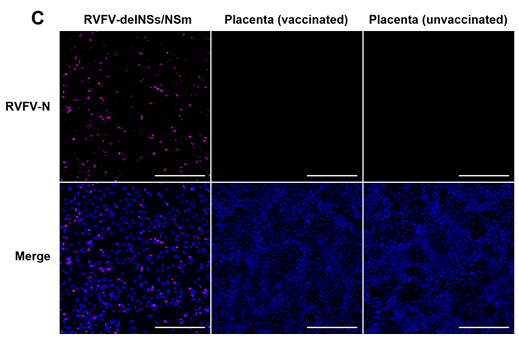
Immunofluorescent images of Vero E6 cells inoculated with placental homogenate.
The live-attenuated RVFV vaccine also spreads minimally throughout the pregnant dam when vaccinated during early gestation at a high dose (1 x 10^5 PFU of RVFV-delNSs/Nsm). Live virus could not be isolated from placental homogenates of two pregnant dams sacrificed prior to giving birth. Two other pregnant dams vaccinated during early gestation delivered normal litter sizes with no apparent congenital abnormalities. These results indicate that there is limited clinical impact on the health of offspring when pregnant individuals receive the live-attenuated vaccine during gestation even at high doses.
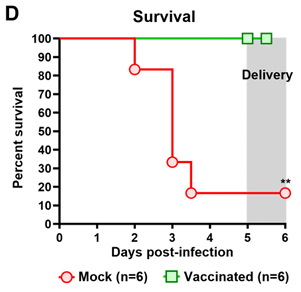
We also demonstrated vaccinated pregnant animals survive challenge from RVFV after vaccination with the live-attenuated RVFV-delNSs/NSm and sufficiently protect fetuses from in utero transmission of RVFV. Surviving animals had very low levels of vRNA detected in maternal and placental samples, with vRNA found in the fetal viscera. Infectious virus was also not found in maternal, placental, or fetal samples from these vaccinated animals indicating vaccination reduced viral burden and in utero transmission, protecting both dam and pup from RVFV clinical disease.
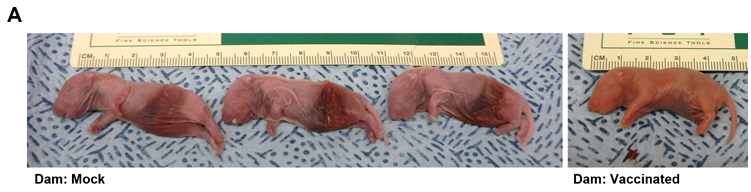
Mock-vaccinated dams delivered pups with visually apparent visceral hemorrhage and lower birth weights in comparison to vaccinated dams after surviving viral challenge. 3 of the 8 delivered pups from the lone surviving mock-vaccinated dam had this congenital abnormality while vaccinated dams that survived viral challenge delivered largely healthy litters with only 4 pups out of 70 being found dead at delivery. Viral RNA in the fetal viscera of vaccinated dams was also minimal especially in comparison to the high levels of vRNA in the fetal viscera of the mock-vaccinated dams.
Vaccination prior to pregnancy was also shown to protect dams and fetuses from RVF during future pregnancy, with female rats paired with males 10 days post vaccination that became pregnant surviving viral challenge with wild-type RVFV while all mock-vaccinated dams succumbed to lethal infection.
All in all, these findings display robust evidence for the safety and efficacy of the RVFV-delNSs/NSm in pregnant animals. This work provides a useful platform and building block for the use of the live-attenuated RVFV strain as a safe and viable vaccine platform for pregnant individuals. Incredible work, Austin!