
Another one of Dr. Kaleigh Connors’ studies has just been published, that’s two published articles in two months! Appearing in the February edition of PLOS Pathogens is the culmination of Dr. Connors’ work on characterizing the replication of historic and contemporary isolates of Oropouche virus (OROV) in neural cells. Entitled “Neural cells are susceptible to historic and recently emerged Oropouche virus strains,” the paper features work from multiple former members of our group across many model systems to elucidate the neuropathogenic potential of OROV.
OROV is a bunyavirus that is distantly related to RVFV. OROV is notable because it has caused a substantial regional outbreak from 2023-2025 in South and Central America. There were significant numbers of cases of people who developed serious neurological issues (Guillain-Barre syndrome) and brain developmental issues during pregnancy (microcephaly).
This study addresses the gap in published knowledge on OROV’s ability to infect cells of the central nervous system (CNS). Using immunofluorescent microscopy to detect viral antigens, we demonstrated that the historical strain of OROV (called BeAn19991 and was isolated in 1960) infects and replicates within immortalized neurons, microglia, and astrocytes.

Immunostained primary rat cortical neurons at 24HPI.
Permissivity of primary neural progenitors to OROV-BeAn19991 infection was also demonstrated in both human induced pluripotent stem cell-derived neuroprogenitor cells and primary rat cortical neuron cultures. These are physiologically relevant models more accurately representing the state of OROV infection of neural cells in vivo. We also utilized two emergent viral strains (OROV-AM0088 and OROV-240023), both of which were obtained during the 2024 outbreak. Although cells were slightly less susceptible to OROV infection by these strains, the results demonstrate the potential for OROV infection across host species and viral strains.
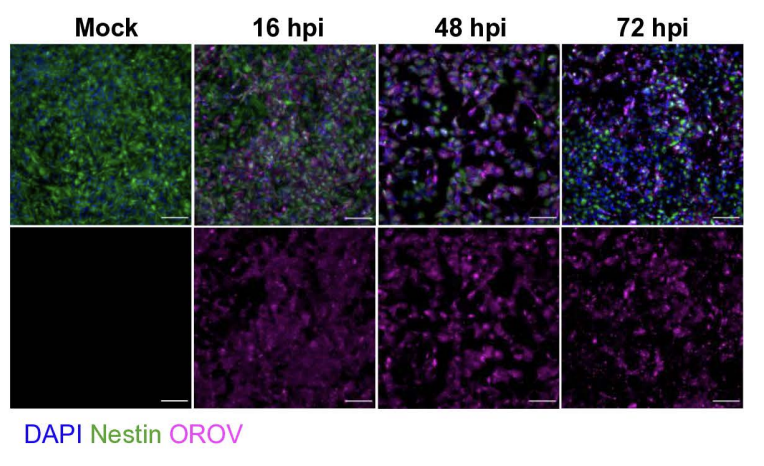
OROV replicates to high titers in human induced pluripotent stem cell-derived neuroprogenitor cells!
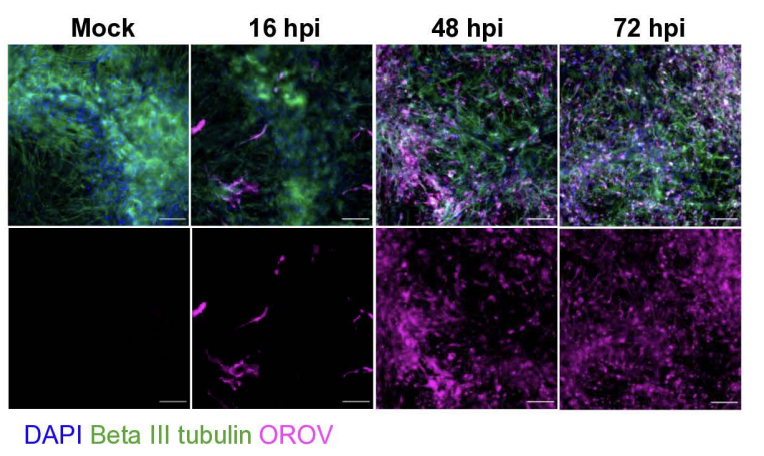
And in hiPSC-derived neurons too! Ooooo how pretty!
Building off Dr. Connors’ previous work with Rift Valley fever virus, we established rat ex vivo brain slice cultures as a model for neurovirulent infection of bunyaviruses. This same model was used to demonstrate viral growth kinetics and immune response in a more approximately intact CNS infrastructure. The results from all three OROV strains indicate local inflammatory responses (induction of type I interferons IFN-α and IFN-β, cytokine IL-1β, and the chemokine MCP-1).
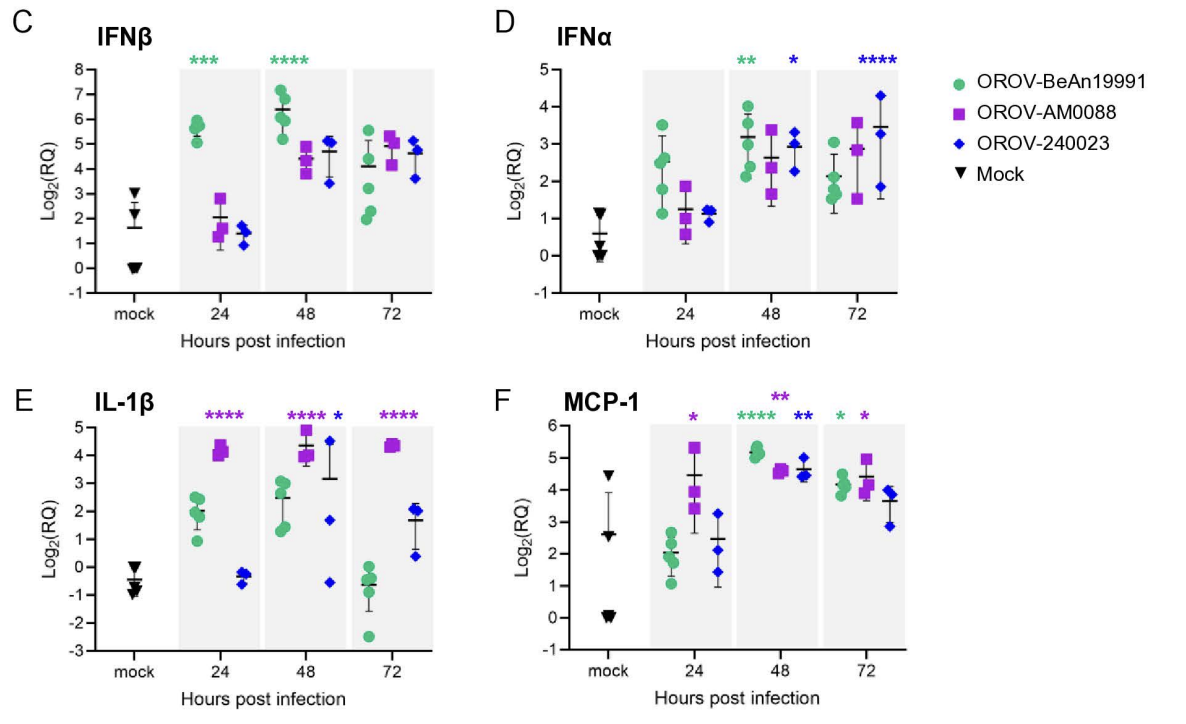
Look at all of that inflammatory response!
Collectively, these findings provide strong evidence that both historical and newly emerged OROV strains are neurotropic and capable of replicating in diverse neural cell types. By establishing in vitro and ex vivo CNS models for OROV infection, we lay essential groundwork for future neuropathogenesis and immune response work in OROV and similar bunyaviruses. Exceptional work, Dr. Connors!
Written by Gia Romano